Gummies & Carrageenan

Manon Kerremans
Manager Innovation Centre
Jun 2026
5 min read
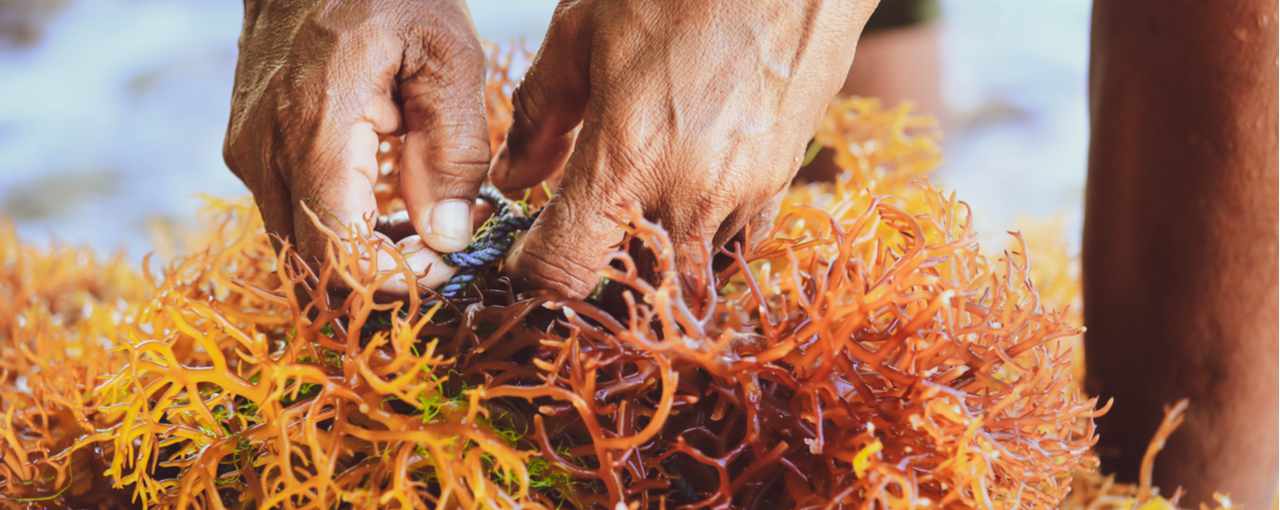
Carrageenan is a naturally occurring polysaccharide extracted from red seaweeds. It is used in the food industry as a gelling agent, but it can also be applied as a soluble dietary fiber. As all hydrocolloids, carrageenan has its own characteristics properties, functional behavior and gelling mechanism. Carrageenan is particularly known for its ability to form gels in the presence of potassium and calcium ions, the formation of thermo-reversible gels and its synergistic behavior with other food hydrocolloids.
Carrageenan is vegan and relatively inexpensive. It is used to replace gelatin, because it has a more elastic texture, compared to pectin. It costs between €10 and €16 per kilogram, with a typical usage rate of 1.5% to 2.5%. In comparison, gelatin costs between €5 and €10 per kilogram, but requires a higher dosage of 5% to 7%. Pectin costs between €15 and €25 and it typically dosed at 1.5% to 3.5%, depending on the type of pectin.
There are three different types of carrageenan:
- Kappa
- Iota
- Lambda
In confectionary, Kappa carrageenan and Iota carrageenan are primarily used, because Lambda carrageenan functions only as a thickening agent rather than a gelling agent. Kappa carrageenan forms strong, brittle gels, while Iota carrageenan creates soft, elastic gels. Combinations of Kappa and Iota carrageenan are often used to make confectionery products with unique textures. The gelation of carrageenan is independent of pH levels or dry solid, it simply occurs upon cooling. The pH needs to be taken into account though, because under pH 3.8 carrageenan cannot form stable gels. The gel will lose its viscosity and gel strength capabilities. As long as the pH is above 3.8, the gel will be stable. To create acidic flavors in combination with carrageenan buffer salts are required to keep the pH above 3.8. Furthermore carrageenan breaks down under the presence of heat and in combination with a pH under 5.5. It is therefore important that acid is added in the very last stage of the process, right before depositing.
As described, gelation is not dependent on the solid content itself, but the solid content influences the gelling temperature. A water solution with carrageenan typically gels around 40-50°C. However, with added sugar and high solid content, the gelling temperature can increase to up to 100°C. Generally, a maximum depositing solid content of 76% is recommended with a depositing temperature of 100°C, as higher solid content can cause the mass to rapidly gel at this high temperature. Since a lot of water is needed in the process, gums and jellies with carrageenan as their main gelling agent are mostly made on starch molding lines.
Heat is required to solubilize Kappa and Iota carrageenan. Furthermore high shear mixing is required, as with pectin, to prevent lumping. Next to that a lot of water is needed for the hydration of carrageenan. The water used for hydration and solubilization should be demineralized, as Kappa and Iota carrageenan are highly reactive with potassium and calcium ions. While it can be beneficial to have some mineral ions present after cooking, to create a strong gel, they should not be introduced at the start of the process. Below are the characteristics of the three different types of carrageenan listed in a table.

Another characteristic of Kappa carrageenan is that it has the tendency to sweat. This can be prevented by adding another hydrocolloid like, Iota carrageenan, gelatin or gum arabic. The different characteristics of carrageenan, like the reactivity with positive ions and the instability at low pH makes carrageenan less suitable to be used in functional gummies. This is as vitamins and minerals often have an effect on the ions present and the pH of the solution.
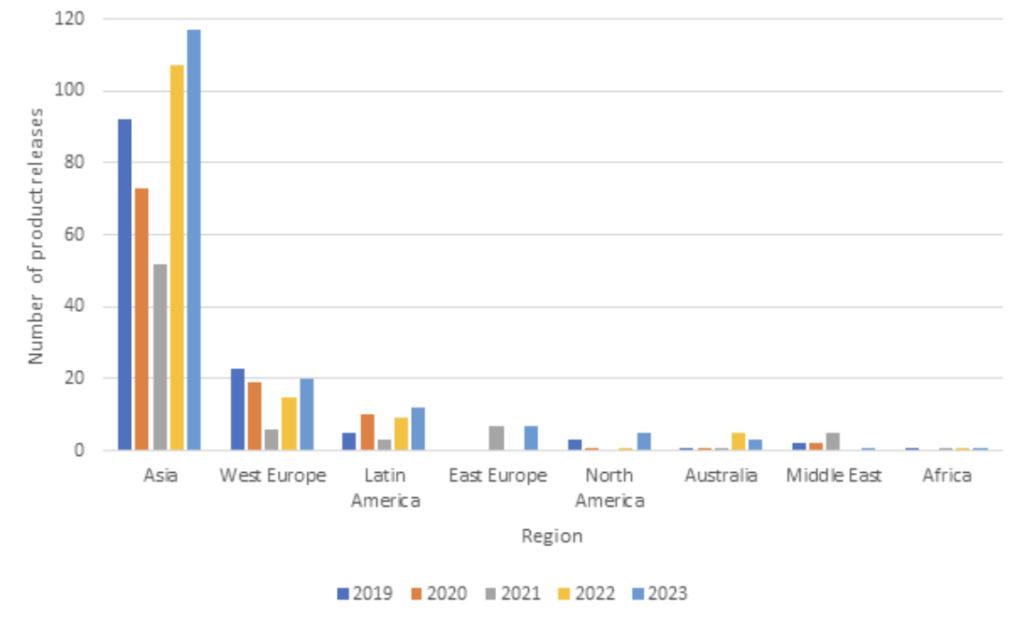
Looking at the amount of new product releases for gums and jellies with carrageenan as their main gelling agent, it is small compared to the three most commonly used gelling agents in confectionery, gelatin, pectin and starch. Of the new releases the far most are introduced in Asia. As can be seen in the graph below, it is obvious that carrageenan is most popular in that region.
Summary
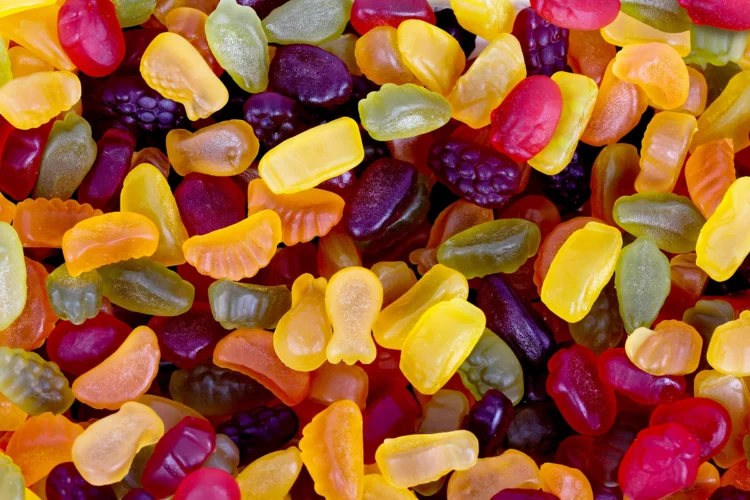
Carrageenan is a vegan gelling agent that can be used for the production of gums and jellies. Kappa and Iota carrageenan are moistly seen in gums and jellies. Processing gums and jellies with carrageenan as the main gelling agent is not the easiest process, but it is an interesting gelling agent to create unique textures with. It is important to use water of good quality that does not contain any positive ions like potassium or calcium. High shear and enough water is needed to properly hydrate and solubilize carrageenan. The dry solid content of the final mass should not exceed 76% dry solids and the pH should be above 3.8. If acid is added for flavor purpose, it should be added at the very last stage before depositing and buffer salt must be used to make sure the pH is at the right level. Since a lot of water is used in the production of gums and jellies with carrageenan, they are mostly produced on starch molding lines. Gums and jellies with carrageenan are most popular in Asia.
Our team of Food Technologists can assist with the development of your recipes. Contact us for a collaborative session to experiment with and test recipes on an actual production line, all in the strictest confidence.